Gidraf Wachira
Senior Programme Manager | Programme Director
I turn zero-to-one digital programmes into governed, funded, scalable systems across Africa and Asia, then hand them to teams who run them without me.
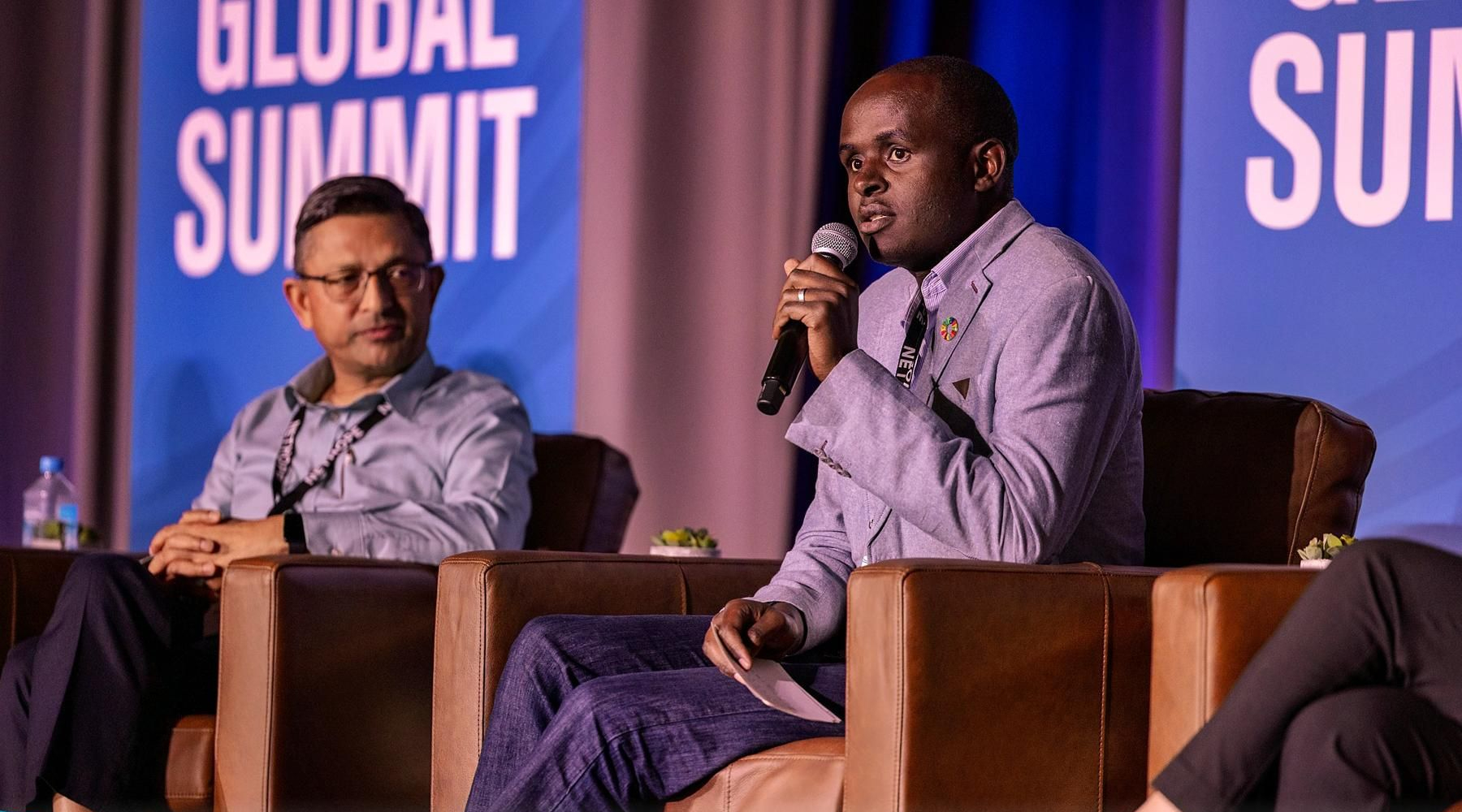
Senior Programme Manager | Programme Director
I turn zero-to-one digital programmes into governed, funded, scalable systems across Africa and Asia, then hand them to teams who run them without me.
I'm a Senior Programme Manager with 12+ years of experience designing, launching and scaling digital programmes in climate, agriculture and health across Africa and Asia. I'm now moving into global programme director roles, where the job is to set strategy, steward money, manage risk and build the teams and partnerships that deliver at scale.
I have led four digital initiatives from the ground up, reaching 2.5M+ people in 10+ countries. At NetHope I was principal director and budget owner of a $1.5M+ annual climate portfolio across 7 countries and 23+ partners, with 100% donor compliance and 95%+ budget adherence. At Mezzanineware (Vodacom Group) I scaled Connected Farmer to 250,000+ smallholder farmers, with a 73%-122% income uplift.
I work in PRINCE2 and agile ways, with Monitoring, Evaluation and Learning driving adaptive management. My tools are Asana, Salesforce, Google Workspace and Miro. I speak fluent English and native Swahili, and I have led multicultural remote teams across time zones. I hold a BBA (Marketing) from Makerere University, PRINCE2 Foundation and Practitioner certification, and a Climatebase Fellowship (Cohort 9), and I am pursuing the Certified Carbon Management Leader designation. I was a Young African Leadership Initiative fellow in 2017.
What the role demands, and the evidence I bring for each.
Setting direction, defining the theory of change and securing long-term backing.
Owning budgets, forecasts and the movement of donor money.
Keeping programmes accountable, audit-ready and safe to scale.
Winning trust with funders, governments, the private sector and communities.
Building and coaching remote, multicultural, cross-functional teams.
Standardising delivery so results don't depend on one person.
Testing ideas cheaply, learning fast and scaling what works.
Each one follows the same shape: summary, challenge, approach, results and takeaway.
I directed 4 multi-country digital programmes across health, agriculture and climate, covering 10+ East African, West African and South-East Asian countries, with governance and performance systems built for each context.
Each programme sat in a different regulatory, cultural and donor environment, in remote-first delivery, and needed rigorous governance alongside room to adapt.
At this scale you need structure that holds under pressure and enough flexibility to adapt.
I designed adaptation and climate-smart agriculture strategy and moved capital to the partners who could deliver it, across 7+ markets.
Strategy only counts when it becomes funded, accountable action, and small community organisations need a process they can actually complete.
Simple, well-documented grant processes widen who can get funded while strengthening compliance.
In June 2026, as head of NetHope's Climate Intersections programme, I led this project with ITU, GSMA, UNDRR, Uganda's Office of the Prime Minister and the Ministry of ICT to train district disaster management leaders in community early warning systems (CEWS). The three-day course in Entebbe covered 10 disaster-prone districts: Amuru, Bududa, Butaleja, Kampala, Kamuli, Manafwa, Moroto, Ntungamo, Pakwach and Sironko.
Uganda has national hazard data and a monthly early warning bulletin, yet warnings often stall at the district office. Floods, droughts, landslides and lightning hit communities that are remote, poorly connected and last to hear. Roles are unclear, funding is thin and local committees have had little training.
Knowledge is quick to build, but lasting change needs funding and follow-up. Only 58% of participants felt fully confident to design a CEWS, so the next step is quarterly action-plan reviews and rolling the training down to parish and village level.
From May 2024 to May 2025, I led NetHope's Climate Intersections pilot to give 16 community-based organisations (CBOs) and county government actors in Tana River County, a declared climate disaster area, the skills and connectivity to receive and share early warnings.
More than 370,000 people live in Tana River County, which floods and droughts repeatedly. CBOs knew their communities but lacked stable internet, resources and the ability to interpret climate data, so warnings reached them late or not at all.
When local government joins the training and trusted CBOs hold the tools, communities act early instead of waiting for outside help. The model was built to be replicated.
As head of Climate Intersections, I led NetHope's funding and strategic oversight of two community climate data projects with Ushahidi: in Yumbe District, Uganda (2025, with YUGNET) and in Ondo, Osun and Oyo States, Nigeria (July to December 2025, with YARN). Both paired low-tech community data collection with validation by local stakeholders.
Climate decisions in these places rest on thin local data. Yumbe faces drought and deforestation, with land and water under pressure in a district of 945,100 people that includes about 198,500 refugees in Bidibidi settlement. Southwest Nigeria faces erratic rain, flooding, heat and erosion. Community knowledge rarely reaches planners.
Communities already hold detailed climate knowledge. Local data champions and validation are what make it credible enough for officials to act on.
I built partnerships across public, private and nonprofit sectors to strengthen health, climate and agricultural systems.
Governments, corporates, donors and community groups work on different timelines and incentives.
Partnerships last when each partner clearly gains something real.
I built the SOPs, risk tools and templates that let multi-country programmes run consistently and be handed over.
Without documented process, delivery depends on individuals and slows as programmes grow.
The best SOP is firm on what matters and flexible everywhere else.
I launched four digital initiatives in health, agriculture and climate, two of them award-winning, and was the inaugural programme leader in three organisations.
Starting from nothing means no playbook and no proof, so assumptions need testing before money is committed.
Learn cheaply first, then scale what communities actually use.
The programmes behind the results.
Global Climate Intersections Lead | NetHope
Led NetHope's global digital resilience programme: strategy, a $1.5M+ annual portfolio and 23+ partners across 7 countries, the full grant lifecycle, and community early warning systems.
View projectClimate Intersections | NetHope | June 2026
A Climate Intersections project I led with ITU, GSMA, UNDRR and the Government of Uganda: a three-day training for 10 districts that lifted participants' test scores by 19.7 points and produced 10 district action plans.
Climate Intersections | NetHope | Kenya | May 2024 - May 2025
A pilot funded by the Internet Society Foundation that trained 16 CBOs and county government in community early warning and equipped them with solar-powered Starlink kits. CBOs report reaching 200,000+ people with hazard alerts.
Climate Intersections | NetHope with Ushahidi, YUGNET and YARN | 2025
Community climate data projects in Yumbe District, Uganda (1,752 community members) and Ondo, Osun and Oyo States, Nigeria (9,506 submissions), validated with local officials and turned into policy-ready recommendations.
Programme Manager | Mezzanineware, Vodacom Group
Scaled a market-led ag-tech marketplace across Kenya, Uganda and Tanzania to 250,000+ farmers, bringing together partnerships, SOPs and a remote team of 8.
View projectInaugural Programme Manager and Country Manager | Dodore Limited
Built the Rwanda operation from scratch, with local teams, governance, a $500K+ budget and input financing for 40,000+ farmers.
View projectPilot Lead and Regional Coordinator | Dodore Limited
Designed and piloted a digital health finance solution that now connects 2.5M+ people to 2,000 medical facilities.
View projectA UN report I contributed to, articles I wrote, talks I gave, video and press features, from NetHope, its partners and my earlier Agri-wallet work.
Contributor and peer reviewer | ITU, WMO, UNDRR and IFRC | July 2026
I am acknowledged as a contributor and peer reviewer of this joint UN report, launched on 7 July 2026 at the AI for Good Global Summit in Geneva. It assesses how AI can strengthen all four pillars of early warning systems, and it cites NetHope's community-voice work in Northern Uganda and Nigeria.
View reportArticle by me | NetHope, 2024
I wrote about why climate adaptation must be community led and owned, and how NetHope's Climate Intersections work puts early warning systems and resilient connectivity in the hands of community organisations.
Read moreInterview and blog | NetHope
Part of a series on NetHope's 2024-2030 strategy, where I explain the role of technology, data and early warning systems in helping NetHope's members and communities adapt.
Read moreSpeaker | NetHope Africa Chapter meeting
I presented the three pillars of Climate Intersections to the region's NetHope members: early warning, upskilling nonprofits with data and digital skills, and climate equity.
Read morePanel | 12th ICT4D Conference, Accra, Ghana, 2024
I spoke on this panel about the barriers smallholder farmers face in accessing and sharing information and data.
Read moreGrantmaking | NetHope, Climate Intersections Grant Program
I announced the new grantees under the Cisco and NetHope Digital Breakthrough Initiative, funding digital climate solutions and youth climate champions.
Read morePartner publication | Ushahidi, COP28
The report records the Ushahidi and NetHope partnership launched at COP28 to pilot community-voice climate data in Uganda, with me pictured among the leadership team.
Read moreProfile | NetHope
My official NetHope biography, covering my role, my earlier eVuna and Connected Farmer work, and my YALI and Makerere background.
Read moreProgramme page | NetHope
The home of the programme I led, with its articles, grantee stories and the Climate Intersections Working Group.
Read moreVideo interview | Agri-wallet, Dodore | 2018 Horticulture Innovation Lab annual meeting, Kigali
In this on-camera interview I explain how Agri-wallet gives smallholder farmers, input suppliers and off-takers flexible financing.
WatchPress feature | The Standard, FarmKenya Initiative
I explained how Agri-wallet links agribusinesses, farmers and input suppliers, and how farmers can use tokens to buy inputs and access advance financing.
Read morePress feature | Business Daily Africa
I described how Dodore's credit to dairy cooperatives lets them pay farmers on time, and how farmers are trained in financial discipline before joining.
Read morePress feature | Business Daily Africa
Agri-wallet is listed first among agriculture innovations, with my explanation of how cooperative payments feed farmers' wallets for buying inputs.
Read moreMore posts and updates on my LinkedIn profile.
A full CV is available on request, and my LinkedIn profile has the complete timeline.
BBA (Marketing), Makerere University, 2010
PRINCE2 Foundation and Practitioner; Certified Carbon Management Leader (in progress)
Climatebase Fellow, Cohort 9 (2026); YALI East Africa Fellow (2017)
Book a free call to talk about senior programme and programme director roles.
Telephone: +254 700 636 470
Email: gidrafwachira86@gmail.com